Attacking your own system before somebody else does
Week 9 · Wednesday 25 November 2026 · 10:00–13:00
AI for Business and FinTech · European School of Economics, Florence
Today is about your capstone, not about ethics in general
| 10:20–11:10 | what your model relies on, and how it treats people |
| 11:20–12:20 | red-team your own pipeline, as code, with the results written down |
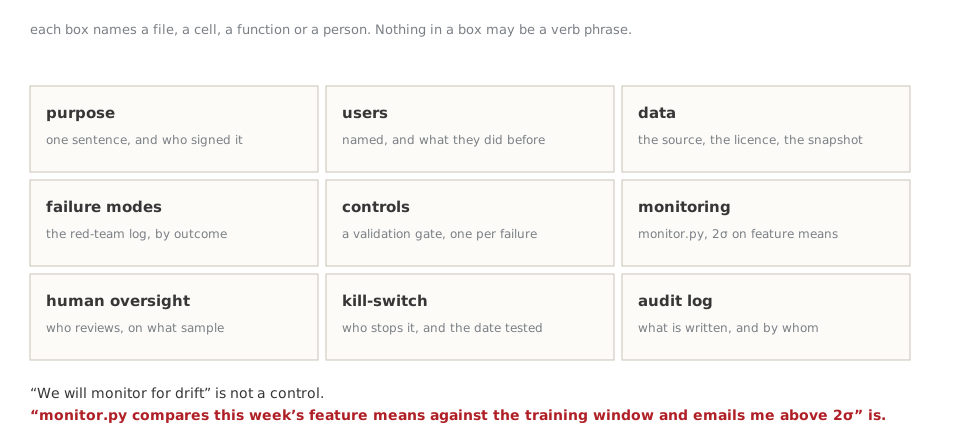
| 12:20–12:50 | the risk and controls canvas — nine boxes, all of them specific |
Everything today produces an artefact that goes into the portfolio. Nothing today is a discussion.
Last week, in one slide
On-chain, the code is the counterparty. A stablecoin is a claim; a governance token is not.
An AMM keeps x · y = k: every trade moves the price, and a liquidity provider carries impermanent loss.
TVL measures size, not profit; fee yield ≈ fee × volume ÷ TVL × 365.
MiCA asks one question: what is the holder owed, and by whom?
Block A What is it relying on?
Two different questions, often confused
Global What does the model rely on, across a period?
For the model card, and for the validator.
Local Why did it say that, on that day?
For the person affected, and for the regulator.
A SHAP value is a feature’s share of the distance between one prediction and the average prediction — on the rows you chose to explain.
Change the rows and the explanation changes. Compute it on the period you are reporting, not on whatever was in memory.
The trap in writing it up
The explainer’s base value is in log-odds, not probability.
“The model started at 0.4 and this feature added 0.3” is wrong if 0.4 was a log-odd. Convert before you write the sentence, or the sentence is false in a document with your name on it.
Block B How does it treat people?
Measure three things, by group
| approval rate | who gets through |
| error rates, by type | who gets the false rejections, who gets the false approvals |
| calibration | does a score of 0.7 mean the same thing in each group? |
Then the result that is not negotiable: when base rates differ, equal approval rates, equal error rates and equal calibration cannot all hold.
It is a theorem, not a modelling failure. Someone chooses which to satisfy, writes down why, and owns it.
And every mitigation is paid for by somebody
Name who pays, in the same sentence as the fix.
Raise approvals for one group and either more bad loans are written, or the bar rises for someone else. A mitigation with no cost attached has not been thought through.
Block C Red-team
A list of things that should break it, run as code
Not a conversation. A file, with outcomes recorded.
| adversarial input | empty, enormous, wrong type, wrong encoding, hostile text |
| corrupted data | a column of nulls, a shifted date, a wrong unit |
| leakage audit | perturb row t+k, see whether the feature at t changes |
| prompt injection | a document that instructs your pipeline |
Three outcomes, and only one is acceptable
Crash Bad, but honest — you find out.
Silent Worst. A wrong number, delivered confidently.
Refused A deliberate refusal, with a message saying why. This one.
The leakage audit in one line
Perturb the data at t+k and recompute the feature at t. If it changed, there is a leak — and no split will ever find it, because the leak is inside the feature.
Attack yours
LAB · session.ipynb § C
Run the harness against your own capstone pipeline.
- Record every outcome: crash, silent, refused.
- Fix the silent ones first. They are the dangerous class.
- Add a validation gate for each — one line, one message.
- Re-run and record again.
That before-and-after log is a required part of the portfolio. Write it as you go; it cannot be reconstructed afterwards.
Block D The canvas
Nine boxes, every one a specific noun
Three questions to finish
- Kill-switch: who stops it, how fast, and has that been tested?
- Override: who can change an output, and where is that written down?
- Audit log: when either happens, what is recorded, and by whom?
An untested kill-switch is a diagram. Test it once, today, and note the date.
Close
Homework 9 — the near-final capstone prototype, a completed risk and controls canvas, and the red-team log: what you attacked, what happened, what you fixed.
Due Tuesday 1 December, 23:59.
Next week we turn the prototype into a decision with numbers, and you rehearse.
AI for Business & FinTech · ESE Florence