The tool that finds the top of any hill
Week 2 · Thursday 1 October 2026 · 10:00–13:00
MBA03 Research & Quantitative Business Methods · European School of Economics, Florence
Homework 1, at the board
PAPER · 15 minutes
One of you takes us through it. Pick one drill you got stuck on. We want the working, the wrong turn included.
Not an exam: the point is to see how you got there.
Last week, in one minute
Block AHow many bikes before we stop losing money?100 — fixed cost ÷ contribution: 60,000 / 600
Block BHow many bikes should we make?150, for €30,000 — vertex −b/2a; profitable between 63 and 237
Block CHow long until revenue doubles?6.1 years — unknown in the exponent: t = \ln 2 / \ln 1.12
Block DIs this battery cell within spec?No — |c - 500| \le 15 means [485, 515]; 483 is out
The vertex formula only works for parabolas. Today: the tool that works for any curve.
Arno Bikes, on one card
| the firm | |
|---|---|
| fixed cost | €60,000 / month |
| variable cost | €400 / bike |
| list price | €1,000 / bike |
| demand | p = 1600 - 4q |
q = bikes per month. Nobody remembers this by heart: it stays on the slide.
| the equations | from | |
|---|---|---|
| cost | C(q) = 60{,}000 + 400q | wk 1 · A |
| revenue at list price | R(q) = 1{,}000q | wk 1 · A |
| revenue with demand | R(q) = pq = 1600q - 4q^2 | wk 1 · B |
| profit = R - C | \pi(q) = -4q^2 + 1200q - 60{,}000 | wk 1 · B |
| average cost | AC(q) = C(q)/q | today · B |
At list price: break-even at 100 bikes. With demand: best output 150 bikes for €30,000; break-evens at ≈ 63 and ≈ 237.
Where we are
| Wk | Date | What you can do by hand |
|---|---|---|
| 1 | 24 Sep | equations, quadratics, logs ✓ |
| 2 | 1 Oct | read a function; limits; the derivative; first integrals |
| 3 | 8 Oct | study a function; optimise |
| 4 | 15 Oct | interest, discounting, NPV |
| 5 | 22 Oct | bonds, duration, convexity |
Today serves both assessments.
The midterm asks you to study a cost, a revenue and a profit function. Everything in that study is built on the derivative.
Three of the five items in the final’s calculus question are here: a limit that factors, a derivative term by term, and a function recovered from its derivative.
Last week you found the top of a hill with a formula that only works for parabolas. Today you get the one that works for any curve.
First, the midterm
BRIEFING · 35 minutes · before any mathematics
The midterm, in four lines
| what | 1,500-word paper (±10%) + oral, max 15 min |
| weight | 25% of the module: paper 80%, oral 20% |
| paper due | Sun 1 Nov, 23:59, on Turnitin |
| oral | week 6 |
What we do in the next 35 minutes
- Read the brief together, line by line.
- Fix the checklist of a full study of a function:
domain → limits → range → sign → max & min → convexity & inflection → sketch. - What the written sections want; Harvard referencing.
- Plan backwards from 1 November.
Questions now, not in the last week of October.
Four blocks today
Block AWhat a function is, once you have to use onedomain · the four shapes
Block BWhat happens near a point you cannot reachlimits
Block CWhat does one more bike do to profit?the derivative
Block DFrom the marginal back to the totalthe integral
Block A What a function is, once you have to use one
A function is a machine
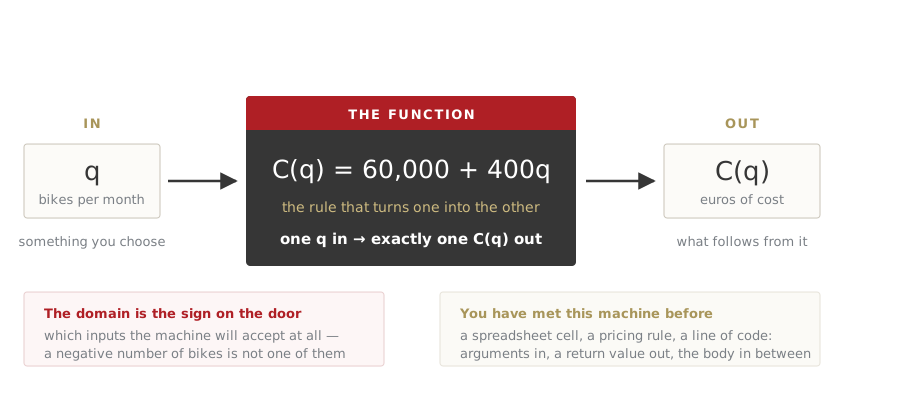
You put something in, something comes out, and what happens inside is the function.
The one rule: each input gives exactly one output. Put in 50 bikes, get one cost — never two.
A spreadsheet cell, a pricing rule, a line of code: the same picture. Keep it all term.
This is my half of the course, in one sentence
Take a function a firm lives by, and study it until you can say what it does.
Midterm — study a cost, a revenue and a profit function, and sketch each one.
Final exam — five questions in three hours; one of them is pure calculus: limits, derivatives, integrals, by hand.
Today: the first pieces of the study (domain, limits, the derivative). Next week: the whole procedure.
Four functions, one firm
| straight line | C(q) = 60,000 + 400q |
| parabola | π(q) = −4q² + 1200q − 60,000 |
| exponential | R(t) = 1.2 · 1.12ᵗ |
| logarithm | R(q) = 30 ln(q + 1) |
Each one is a sentence about a business, written so it can be computed.
Domain is the first question, always: for which q does this mean anything?
\begin{aligned} \sqrt{q-20} \;&\text{ needs } q \geq 20 \\[2pt] \ln(q-5) \;&\text{ needs } q > 5 \\[2pt] \tfrac{120}{q-40} \;&\text{ breaks at } q = 40 \end{aligned}
The exam asks “state the domain” and expects an interval, with the bracket chosen on purpose.
Bet before we compute
π(100) and π(200). One is bigger. Which, and by how much?
Nothing here is memorised. Each rule is a question with no answer.
Ask what the symbol is asking for, and the restriction falls out on its own.
| the symbol | the question it asks | when there is no answer |
|---|---|---|
| \sqrt{x} | what number, times itself, gives x? |
x < 0 — a square is never negative |
| \ln x | to what power must e be raised to give x? |
x ≤ 0 — a positive base never reaches zero |
| \dfrac{a}{x} | how many x fit into a? |
x = 0 — nothing fits into nothing |
So \sqrt{q-20} needs the thing inside, not q, to be at least zero: q − 20 ≥ 0.
Three rules, or one habit: put the bracket’s contents where the rule’s own question can be asked. You will never have to remember which is ≥ and which is > — √0 = 0 is fine, ln 0 is not.
D1, D2 — domains, and the four functions
PAPER · drills.md
10 minutes. Show all work, exam style. I walk round and look at your working.
Four blocks today
Block AWhat a function is, once you have to use onedomain · the four shapes
Block BWhat happens near a point you cannot reachlimits
Block CWhat does one more bike do to profit?the derivative
Block DFrom the marginal back to the totalthe integral
Block B Limits — what happens near a point you cannot reach
What does one bike cost? It depends how many you make.
The rent is €60,000 whether you build one bike or a thousand. Split it between the bikes — cost C(q) from week 1, Block A, divided by q:
AC(q) = \frac{60{,}000 + 400q}{q} \;=\; \underbrace{\frac{60{,}000}{q}}_{\text{the rent, shared}} + \underbrace{400}_{\text{the parts, per bike}}
Bet before we compute
At 30 bikes a month, what does one bike cost the firm? At 300?
The rent, split thinner and thinner
The gold bar is the rent per bike. It shrinks; the €400 floor never moves.
Where do you take a limit? Where the domain stops.
Inside the domain there is nothing to ask: substitute and read the value. A limit is for the edges — the places you cannot reach.
| the domain stops… | example | the limit to take |
|---|---|---|
| at a point that is excluded | \dfrac{120}{q-40}, q \neq 40 | from both sides: q \to 40^{-} and q \to 40^{+} |
| at an open end | AC(q), q > 0 | from the allowed side only: q \to 0^{+} |
| never — it runs on | AC(q), q > 0 | q \to +\infty (and -\infty if the domain goes there) |
Recipe: write the domain → list its edges → one limit per edge. AC has domain (0, +\infty): two edges, two limits.
Which is two limits, and a floor
\lim_{q \to 0^{+}} AC(q) = +\infty \qquad\qquad \lim_{q \to \infty} AC(q) = 400
At q = 0 the expression means nothing — you cannot divide by nothing — but you can ask what happens near zero, and the answer is: ruinous. One bike carries the whole rent.
Far out, the shared rent vanishes and average cost settles onto the variable cost. It never goes below €400, because every bike really does need €400 of parts.
Economies of scale, in two limits. And a limit is exactly this: not the value at a point, but the value the function heads towards as you approach it.
The one that looks impossible
\lim_{q \to 10} \frac{q^{2} - 100}{q - 10}
Why at 10? Because 10 is outside the domain (the denominator is zero there): an edge, so a limit. Substitute and you get 0/0, which says nothing. So do not substitute first.
\frac{(q-10)(q+10)}{q-10} = q + 10 \;\longrightarrow\; 20
Board sentence
0/0 is not an answer, it is an instruction: factor, cancel, then substitute.
D4, D5, D6 — limits, including one from the exam
PAPER · drills.md
12 minutes. D5 is a one-sided limit in exactly the form the final exam uses.
Four blocks today
Block AWhat a function is, once you have to use onedomain · the four shapes
Block BWhat happens near a point you cannot reachlimits
Block CWhat does one more bike do to profit?the derivative
Block DFrom the marginal back to the totalthe integral
Block C The derivative
How much does one more bike change profit?
At 80 bikes a month, what does the eighty-first bike add?
Bet before we compute
More than €1,000, between €0 and €1,000, or negative? Commit to one.
The honest way to ask it: take two quantities, measure the change in profit, divide by the change in quantity. Then let the two quantities come together.
Two points become one
The slope over an interval becomes the slope at a point.
The definition, once
\pi'(a) \;=\; \lim_{h \to 0} \frac{\pi(a+h) - \pi(a)}{h}
You will use this definition roughly twice in your life. What you will use every day is what it produces:
qⁿ |
n qⁿ⁻¹ |
| a constant | 0 |
a/qⁿ |
a·q⁻ⁿ, then as a power: −n a q⁻ⁿ⁻¹ |
ln q |
1/q |
e^(kq) |
k e^(kq) |
| sums | differentiate term by term |
Differentiating, as a procedure you can follow
Never ask “what is the derivative of this?” Ask the questions in order.
| ask | then |
|---|---|
| 1. Is it a sum? | split it; do each piece alone |
2. A number, no q? |
it becomes 0 |
3. A fraction a/qⁿ? |
rewrite it as a power, a·q⁻ⁿ, and go to 4 |
4. A power a·qⁿ? |
n comes down in front, the power drops by one |
5. A log a·ln(q)? |
it becomes a/q |
-4q^{2} \to -8q \qquad 1200q \to 1200 \qquad -60{,}000 \to 0 \qquad 30\ln q \to \tfrac{30}{q}
\pi(q) = \underbrace{-4q^{2}}_{4} + \underbrace{1200q}_{4} \underbrace{- \,60{,}000}_{2} \;\longrightarrow\; \pi'(q) = -8q + 1200
A lone q is q¹, so rule 4 leaves just the number in front of it.
The fraction. A q downstairs is a negative power upstairs. Then rule 4, unchanged:
\frac{1}{q^{2}} = q^{-2} \;\longrightarrow\; -2\,q^{-3} = -\frac{2}{q^{3}} \qquad\qquad AC(q) = \underbrace{\frac{60{,}000}{q}}_{3} + \underbrace{400}_{2} \;\longrightarrow\; AC'(q) = -\frac{60{,}000}{q^{2}}
The −2 comes down, the power drops by one to −3. The exponent is negative, so the derivative is negative: average cost falls at every q — block B’s economies of scale, now as a sign.
Question 6: is there something inside something?
ln(q + 1) is not ln q. There is a second function hiding inside the first, and the midterm’s revenue function is exactly this shape.
\frac{d}{dq}\,f\big(g(q)\big) \;=\; f'\big(g(q)\big) \cdot g'(q)
Differentiate the outside, leave the inside alone, then multiply by the derivative of the inside.
\ln(q+1) \;\to\; \frac{1}{q+1}\cdot \underbrace{1}_{\text{inside}'} = \frac{1}{q+1} \ln(3q) \;\to\; \frac{1}{3q}\cdot 3 = \frac{1}{q}
(2q+5)^{4} \;\to\; 4(2q+5)^{3}\cdot 2 = 8(2q+5)^{3} e^{0.12t} \;\to\; e^{0.12t}\cdot 0.12
Why ln(q+1) looked free: the inside is q + 1, whose derivative is 1, so the multiplication does nothing and you never saw it. Change the inside to 3q and it shows up.
The chain rule is the reason a few things work
| you will meet it in | as |
|---|---|
| the midterm | a revenue of the form a · ln(q + 1), differentiated to find the optimum |
| week 4 | continuous compounding: e^(it) differentiates to i·e^(it) |
| week 5 | duration: the bond price is (1+y)^(−t), and the −t comes down |
| block D, backwards | ∫ f'/f = ln\|f\| is this rule read in reverse |
Board sentence
Outside first, inside untouched, then multiply by the inside’s derivative. If the inside is just q, the multiplication is by 1 and you never notice.
Read it off the curve
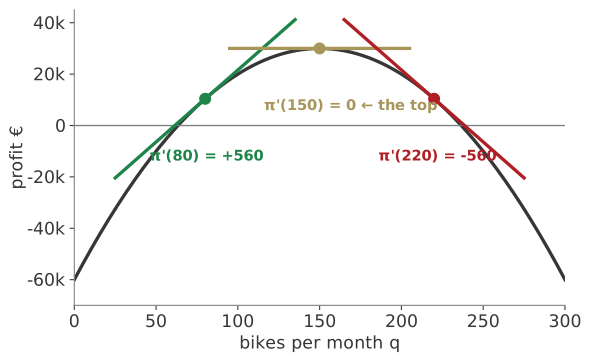
Same curve, three places, three answers to the same question: is the next bike worth making?
The tangent walks the curve
Positive, then flat, then negative. The flat point is the top.
Move the price, watch the slope
LAB · session.ipynb § C
- Bet: if the price cut per extra bike were €3 instead of €4, would the best quantity rise or fall?
- Then slide it, and watch where
π'(q) = 0moves to.
The slider changes one number. The whole answer moves with it.
Last week’s formula, and this week’s
Week 1, only for parabolas: q_v = -\frac{b}{2a} = -\frac{1200}{-8} = 150
Today, for anything: \pi'(q) = -8q + 1200 = 0 \;\Rightarrow\; q = 150
Same answer. But the second one still works when revenue is 30 ln(q+1), or cost is cubic, or the curve has no formula you recognise.
Board sentence
The derivative answers one managerial question: what does one more unit do? Positive means make more, negative means make fewer, zero means stop.
D8, D9 — differentiate, then read the answer
PAPER · drills.md
12 minutes. In D9 write the sentence a manager would say, not just the number.
Four blocks today
Block AWhat a function is, once you have to use onedomain · the four shapes
Block BWhat happens near a point you cannot reachlimits
Block CWhat does one more bike do to profit?the derivative
Block DFrom the marginal back to the totalthe integral
Block D Running it backwards: the integral
From the derivative back to the function
The exam asks this in one direction and the other. Given f', find f.
f'(q) = 6q^{2} - 2q \quad\Longrightarrow\quad f(q) = 2q^{3} - q^{2} + c
The c is not decoration. Every function 2q³ − q² + c has the same derivative, so one extra fact pins it down:
f(1) = 4 \;\Rightarrow\; 2 - 1 + c = 4 \;\Rightarrow\; c = 3
And it means something
Given marginal cost MC(q) = 0.8q + 3, the cost function is
C(q) = 0.4q^{2} + 3q + c
and c = C(0) is the fixed cost — what you pay having produced nothing.
The constant of integration is not a technicality here. It is the rent.
Running it backwards has a name: the integral
\int f'(q)\,dq \;=\; f(q) + c \qquad \text{read: “the function whose derivative is } f'\text{”}
Every derivative rule, read from right to left:
| you know | so, backwards |
|---|---|
| q^{n} \to n\,q^{n-1} | \displaystyle\int q^{n}\,dq = \frac{q^{n+1}}{n+1} + c \quad (n \neq -1) |
| \ln q \to \dfrac{1}{q} | \displaystyle\int \frac{1}{q}\,dq = \ln\lvert q\rvert + c |
| \ln f(q) \to \dfrac{f'(q)}{f(q)} (chain rule) | \displaystyle\int \frac{f'(q)}{f(q)}\,dq = \ln\lvert f(q)\rvert + c |
| a constant \to 0 | \displaystyle\int k\,dq = kq + c |
| sums, term by term | integrate term by term |
Power up by one, divide by the new power. The one power that rule cannot handle, q^{-1}, is exactly the one that becomes a log. And the check is free: differentiate your answer and you must get back what was inside.
The exam’s integral: split the fraction first
The final’s calculus question opens with a fraction to integrate. There is no rule for a fraction — so make it stop being one.
\int \frac{3q^{3} + 4q^{2} - 2}{q}\,dq
= \int \Big(3q^{2} + 4q - \frac{2}{q}\Big)\,dq \;=\; q^{3} + 2q^{2} - 2\ln\lvert q\rvert + c
Board sentence
Divide every term by the denominator, then integrate each piece on its own. The 1/q piece is the one that turns into a log.
When the top is the derivative of the bottom
A log appears whenever the top is the derivative of the bottom — exactly, or up to a constant you can factor out.
\int \frac{1}{q-1}\,dq = \ln|q-1| + c
The bottom differentiates to 1. A shifted log, nothing more.
\int \frac{q}{q^{2}-1}\,dq = \tfrac{1}{2}\ln|q^{2}-1| + c
The bottom differentiates to 2q; the top is q, so put the missing ½ out front.
Before integrating any fraction, ask one question: is the top the derivative of the bottom? If yes, it is a log. If no, divide term by term and use the power rule.
This is the chain rule read backwards, and the final’s calculus question uses it.
The definite integral, and what it measures
Put two numbers on the integral sign: evaluate at the top, subtract the value at the bottom. The c cancels, so leave it out.
\int_{0}^{20} (0.8q + 3)\,dq = \Big[0.4q^{2} + 3q\Big]_{0}^{20} = 220
Add up the marginal cost of the first twenty units and you get what those twenty cost, on top of the fixed cost.
And the one worth remembering, on Arno Bikes’ marginal profit from block C:
\int_{100}^{150} \pi'(q)\,dq = \pi(150) - \pi(100) = €10{,}000
The integral of the marginal is the change in the total. That sentence is the whole of integration.
Board sentence
Differentiate to ask what one more does. Integrate to ask what all of them did.
D11, D12, D13 — recover the function, then integrate
PAPER · drills.md
10 minutes. Exam form: every answer ends with the constant found, not left as c. D13 is the final’s first calculus item, in the same form.
Close Take home
Take home
- Domain first, always. The exam gives marks for the interval.
0/0means factor, cancel, then substitute.- The derivative is the answer to “what does one more do?”
- Running it backwards is the integral: power up and divide,
1/qgivesln, and one fact pins the constant down. Between two limits, it is the change in the total.
Homework 2 (homework.md), for Thursday 8 October, corrected together at the board: eight drills plus a memo to the Board on whether to build the next bike.
Write your own three take-home lines now, before you leave.
← Course site · Research & Quantitative Business Methods · ESE Florence