Money has a date on it
Week 4 · Thursday 15 October 2026 · 10:00–13:00
MBA03 Research & Quantitative Business Methods · European School of Economics, Florence
Homework 3, at the board
PAPER · 15 minutes
One of you takes us through it. The Board report, read aloud by its author. The room says what it would cut.
Not an exam: the point is to see how you got there.
Last week, in one minute
Block AThe study, done properlySeven steps in the brief’s order; f' finds the point, f'' names it
Block BHow much should the firm produce?Until R'(q) = C'(q). Average cost is lowest where MC = AC
QuizWeeks 1–3, five itemsMarked and back today. Step 6, convexity: see the week-3 deck and drills, which now say more about it.
That closes the calculus. Today every euro gets a date.
Where we are
| Wk | Date | What you can do by hand |
|---|---|---|
| 1–2 | 24 Sep – 1 Oct | algebra, limits, the derivative, first integrals ✓ |
| 3 | 8 Oct | study a function, optimise ✓ |
| 4 | 15 Oct | interest, EAR, discounting, NPV, a firm’s value |
| 5 | 22 Oct | bonds, duration, convexity |
A change of subject, not of method.
The calculus is behind you; from here the mathematics is arithmetic done carefully. What is new is that every euro now carries a date, and two euros with different dates cannot be added.
The resit’s multiple-choice block is entirely this and next week.
The case for two weeks
Arno Bikes, a decision
A new assembly line costs €2.4M today and is expected to return €700k, €800k, €900k and €1,000k at the end of each of the next four years. The firm borrows at 9%.
Bet before we compute
It returns €3.4M on a €2.4M outlay. Is that a million of profit? Yes or no — commit before the arithmetic.
Four blocks today
Block AWhat does compounding actually do?simple · compound · e
Block BWhich of two quotes is cheaper?the effective rate
Block CWhat is a future euro worth today?discounting · annuities · growth
Block DBuild the line or not?NPV · IRR
The two weeks, as one map
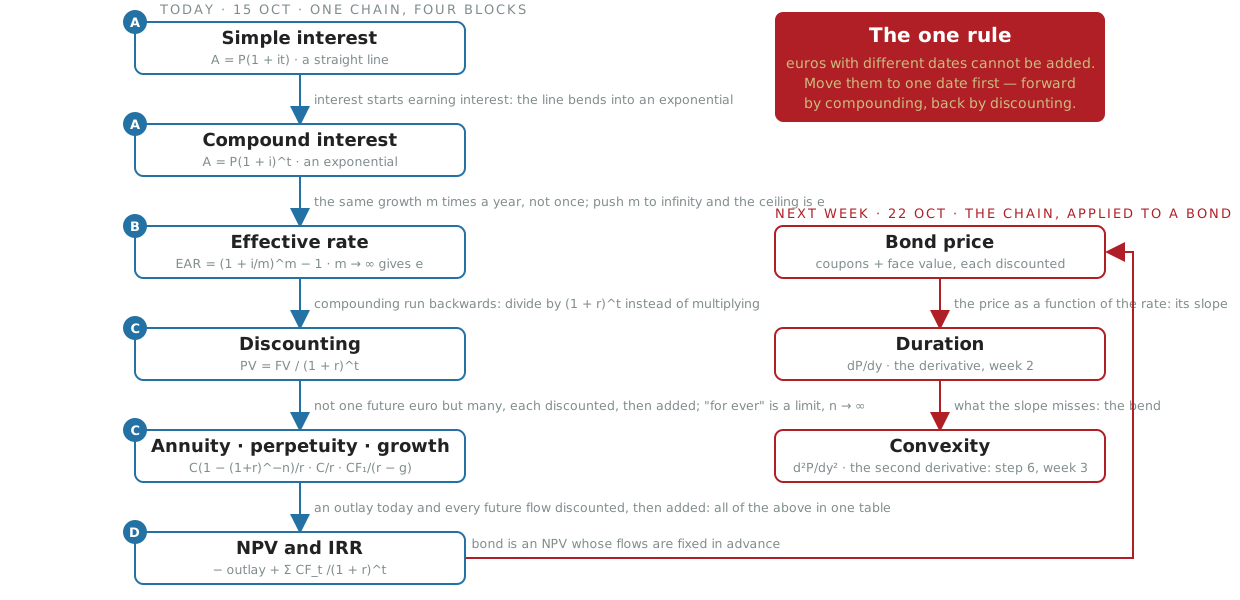
Each box is built from the one before it; the words on the arrow say how. Today the blue chain; Thursday 22nd the red one, and the mock of the final’s calculus question.
Block A Interest, and what compounding actually does
€8,000 at 6%. Build it year by year.
Simple — 6% of the original €8,000, every year. €480, then €480, then €480.
| end of | interest | balance |
|---|---|---|
| year 1 | 6% × 8,000 = 480 |
8,480 |
| year 2 | 6% × 8,000 = 480 |
8,960 |
| year 3 | 6% × 8,000 = 480 |
9,440 |
A = P(1 + it)
P the principal, what you put in · i the rate per year · t the years · A the amount at the end.
The t is a multiplication, because you are adding the same amount t times.
Now 6% of whatever is actually there
Compound — the interest earns interest, so the amount grows too.
| end of | interest | balance |
|---|---|---|
| year 1 | 6% × 8,000 = 480.00 |
8,480.00 |
| year 2 | 6% × 8,480 = 508.80 |
8,988.80 |
| year 3 | 6% × 8,988.80 = 539.33 |
9,528.13 |
A = P(1+i)^{t}
The t is now an exponent, because each year multiplies by 1.06 again. 8,000 × 1.06 × 1.06 × 1.06.
That is the whole difference, and it is visible in the table before it is visible in the formula: one column repeats, the other climbs.
Three years is €88. Ten is not.
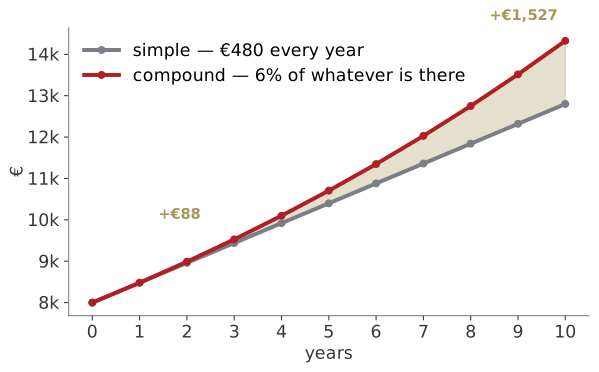
The gold gap is what compounding adds. It is €88 after three years and €1,527 after ten — and it is the same 6% throughout.
Nobody in finance means “simple” when they say interest. It is in the syllabus so that you can name what compounding adds, and so that you recognise the gap when someone quotes you the wrong one.
A rate that moves by one point
€10,000 at 5%, compounded annually. Now the rate moves — up a point, down a point.
Bet before we compute
Over twenty years, on €10,000, how much is one point of interest worth?
| rate | 8 years | 20 years |
|---|---|---|
| 4% | 13,685.69 | 21,911.23 |
| 5% | 14,774.55 | 26,532.98 |
| 6% | 15,938.48 | 32,071.35 |
One point is about €1,100 over eight years and €4,600 to €5,500 over twenty. The rate sits in the base of a power: a point of rate is multiplied by itself t times, and the longer the horizon the more it matters.
More often is more
A = P\left(1 + \frac{i}{m}\right)^{mt}
m is how many times a year interest is added. €5,000 at 8% nominal for 4 years, quarterly: 5000(1.02)¹⁶ = €6,863.93.
Bet before we compute
Compound 12% a year every single day instead of once. How much more than €1,120 does €1,000 become?
The ceiling, and where e comes from
1,120 · 1,123.60 · 1,125.51 · 1,126.83 · 1,127.34 → 1,127.50.
Continuous compounding
\lim_{m \to \infty}\left(1 + \frac{i}{m}\right)^{m} = e^{\,i} \qquad\Longrightarrow\qquad A = P e^{\,it}
In week 1 e was “the base your calculator’s ln uses”. Here it earns its place: it is the ceiling on compounding, and the gap between weekly and continuous is sixteen cents on a thousand euros.
Board sentence
Compounding more often always helps, and always by less. The limit is e.
A is a function — and you know how to study one
A(t) = P(1+i)^{t}, \qquad t \ge 0
| step | ||
|---|---|---|
| 1 · domain | [0, \infty) | time runs forward |
| 2 · limits | A(0) = P; A(t) \to \infty as t \to \infty | no ceiling: a 5% deposit doubles every 14 years, for ever |
| 5 · monotone | A'(t) = A(t)\ln(1+i) > 0 | always rising; and the rise is proportional to what is already there |
| 6 · convexity | A''(t) = A(t)\ln^{2}(1+i) > 0 | convex throughout, no inflection: growth that keeps accelerating |
Simple interest is A = P(1+it): a straight line, A'' = 0. That is the whole difference between the two tables, said with step 6.
Challenge, in the drills: D15 is this study on paper; D16 is the same seven steps on the NPV curve you will meet in block D — its zero has a name.
Four blocks today
Block AWhat does compounding actually do?simple · compound · e
Block BWhich of two quotes is cheaper?the effective rate
Block CWhat is a future euro worth today?discounting · annuities · growth
Block DBuild the line or not?NPV · IRR
Block B The effective rate — the only honest comparison
Two quotes, same nominal rate, different price
EAR = \left(1 + \frac{i}{m}\right)^{m} - 1
| 12% nominal, compounded | EAR |
|---|---|
| semi-annually | 12.36% |
| quarterly | 12.55% |
| monthly | 12.68% |
| continuously | 12.75% |
Bank A: 7.8% compounded monthly.
Bank B: 8% compounded annually.
Bet before we compute
Which do you borrow from?
A: (1 + 0.078/12)¹² − 1 = 8.085%. B: 8.000%. Borrow from B. The lower headline rate is the dearer loan.
A nominal rate is not a price until you know m.
D4, D5 — put everything on the same basis
PAPER · drills.md
10 minutes. Every answer states m explicitly before the arithmetic.
Four blocks today
Block AWhat does compounding actually do?simple · compound · e
Block BWhich of two quotes is cheaper?the effective rate
Block CWhat is a future euro worth today?discounting · annuities · growth
Block DBuild the line or not?NPV · IRR
Block C What is a future euro worth today — and a whole firm?
What is €10,000 in five years worth now?
PV = \frac{FV}{(1+r)^{t}} = \frac{10{,}000}{(1.07)^{5}} = €7{,}129.86
FV the future value, the sum on its future date · PV the present value, what that sum is worth today · r the rate, now called the discount rate · t the years between.
Compounding pushes money forward; discounting pulls it back. Same formula, read the other way.
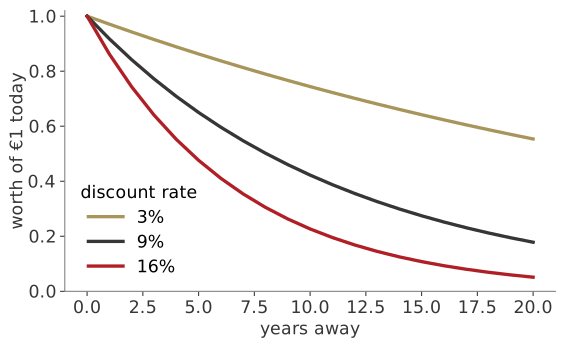
Why is a future euro worth less than one today?
- Opportunity cost. The euro you hold now can be deposited at
rand will have grown by then. A €1,000 bonus paid in a year, with a 4% deposit available, is worth1,000/1.04 = €961.54today — because €961.54 today becomes €1,000 in a year. This is the reason the formula uses. - Inflation. A euro in five years buys less than a euro now. In practice the rate
ryou are quoted already contains it. - Risk. A promised euro may not arrive. The less sure it is, the higher the rate you discount it at.
Cost of capital
The rate a firm discounts at is its cost of capital: what its money costs it. For Arno Bikes today, the 9% it borrows at. Block D shows the fuller version, a blend of what lenders charge and what shareholders expect.
Why the rate matters more than the forecast
At 3%, a euro in twenty years is worth 55 cents. At 16%, five cents.
Two analysts can agree on every cash flow and disagree entirely on the answer, because they disagreed about one number at the front.
Two shortcuts you will use constantly
Most money in business arrives as a stream, not a lump: a lease, a loan repayment, a pension, a dividend, a bond coupon. Discounting each payment by hand is fine for three; for thirty, or for ever, you need the sum already done.
Annuity — the same amount, n times: PV = C\,\frac{1 - (1+r)^{-n}}{r} €12,000 a year for 10 years at 6% → €88,321
Perpetuity — the same amount, for ever: PV = \frac{C}{r} €12,000 a year for ever at 6% → €200,000
For ever is worth only 2.3 times ten years. Everything after year ten adds €111,679, because discounting shrinks distant money towards nothing.
What is Arno Bikes worth?
A buyer asks the Board to name a price for the whole firm.
- next year’s free cash flow: €300k
- growing 3% a year, for ever
- cost of capital: 9%
Free cash flow: the cash the business generates in a year after its costs, taxes and the investment it needs to keep running — what is left for whoever owns it. A firm is a stream of these, so it is priced like one.
With no growth, the perpetuity you just saw:
€300k / 0.09 = €3.33M.
Bet before we compute
With 3% growth — how much? One number, in euros, before any formula.
| Year | Cash flow (€k) | PV at 9% (€k) |
|---|---|---|
| 1 | 300.00 | 275.23 |
| 2 | 309.00 | 260.08 |
| 3 | 318.27 | 245.76 |
| 4 | 327.82 | 232.23 |
| 5 | 337.65 | 219.45 |
| … | grows 3% | shrinks |
Every row adds less than the one before, but the rows never stop.
A perpetuity, with the growth taken off the rate
PV = \frac{CF_1}{r - g} = \frac{300}{0.09 - 0.03} = \frac{300}{0.06} = €5{,}000\text{k} = \textbf{€5M}
Each year’s present value is the last one times \frac{1.03}{1.09}: the table is a geometric series, and this is its sum. With g = 0 it is the C/r you already know.
The first five years are worth €1.23M. The other €3.77M is everything after year five — the value of a firm lives mostly in the far future.
One point of growth is worth a million
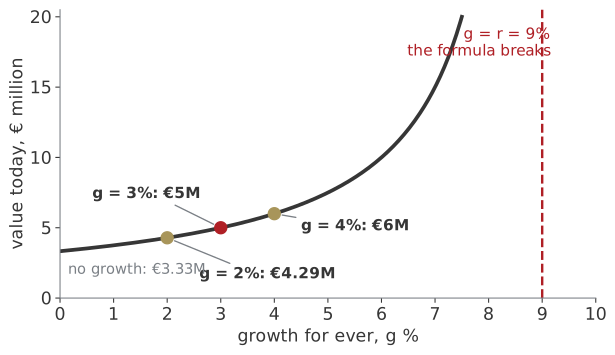
| g | value |
|---|---|
| 2% | €4.29M |
| 3% | €5.00M |
| 4% | €6.00M |
As g \to r the denominator goes to zero and the value explodes — a limit, week 2.
The formula needs g < r. No firm outgrows its cost of capital for ever.
Where the risk in a valuation sits
Board sentence
A firm is worth next year’s cash flow divided by the gap between our cost of capital and its growth. That gap is a few points wide, and every point of doubt in it is a million on the price.
Earlier: two analysts who agree on every cash flow can disagree on the answer because of the rate. Here the rate and the growth sit in one small number, r - g, and that is where to push back.
D8–D11 — present value, annuity, perpetuity, growth
PAPER · drills.md
15 minutes. Show the discount factor separately from the flow, every time. D11 ends with a sentence for the Board.
Four blocks today
Block AWhat does compounding actually do?simple · compound · e
Block BWhich of two quotes is cheaper?the effective rate
Block CWhat is a future euro worth today?discounting · annuities · growth
Block DBuild the line or not?NPV · IRR
Block D NPV — the decision itself
Back to the assembly line
NPV = -2{,}400 + \frac{700}{1.09} + \frac{800}{1.09^{2}} + \frac{900}{1.09^{3}} + \frac{1{,}000}{1.09^{4}}
| Year | Flow (€k) | Factor | PV (€k) |
|---|---|---|---|
| 0 | −2,400 | 1.000000 | −2,400.00 |
| 1 | 700 | 0.917431 | 642.20 |
| 2 | 800 | 0.841680 | 673.34 |
| 3 | 900 | 0.772183 | 694.97 |
| 4 | 1,000 | 0.708425 | 708.43 |
| NPV | +318.94 |
So the bet was wrong
The Board member said “€3.4M back on €2.4M out, a million of profit”.
Adding flows from different years is the one thing this subject forbids. Discounted, the million is €319,000 — still positive, still worth doing, but a third of what it looked like.
Board sentence
Accept a project when its NPV is positive at our cost of capital. The rate is not a detail of the calculation; it is the calculation.
Move the rate, watch the sign
The crossing has a name: the internal rate of return, 14.6% here.
Every block today ran on a rate. Whose?
| Block | The rate was… | Set by |
|---|---|---|
| A | what a deposit grows at | the bank, for you |
| B | the same rate, quoted honestly (EAR) | the bank, compared |
| C | what a euro of yours could earn elsewhere | your best alternative |
| D | the rate the line has to beat | the firm’s own money |
Block C called it the cost of capital and used “the 9% the firm borrows at”. That was a shortcut: a firm’s money never comes from one pocket. So where does 9 come from?
€2.4M, euro by euro — who paid for the line?
| Source | Amount | What it costs a year | After tax |
|---|---|---|---|
| Shareholders, 60% | €1,440k | expect 12% → €172.8k | €172.8k |
| Bank, 40% | €960k | charges 6% → €57.6k | interest is deductible at 25% → €43.2k |
| Total | €2,400k | €216.0k |
216 / 2,400 = 9.0% a year. That is the bill the line must pay, every year, before it has earned anyone a cent. A project with NPV > 0 at 9% pays that bill and leaves something over.
It is a weighted average, nothing more: each source’s rate, weighted by its share of the money. Finance calls it the WACC.
The same table, as a formula
WACC = \frac{E}{V}\,r_e \;+\; \frac{D}{V}\,r_d(1-\tau)
E/V, D/V |
the share of equity and of debt in the financing (0.6 and 0.4) |
r_e, r_d |
what shareholders expect, what lenders charge (12%, 6%) |
(1 − τ) |
interest is tax-deductible, so debt costs less than its rate (0.75) |
0.6(12%) + 0.4(6%)(0.75) = 7.2% + 1.8% = 9.0% — the 9 we have used all morning.
Board sentence
The discount rate is not an assumption you pick. It is the price your own money costs, and using someone else’s number is how projects get approved that should not be.
What IRR is, and what it is not
It is the discount rate at which NPV is exactly zero — the project’s own break-even cost of money, and a useful margin of safety: 9% against 14.6% is comfortable room.
It is not a decision rule on its own. Compare two projects on IRR and you can pick the smaller one; compare them on NPV and you cannot.
Push the cost of capital
LAB · session.ipynb § D
- Bet: at what rate does this project stop being worth doing?
- Then slide, and read the crossing.
- Now delay the first €700k by a year. What happens to the IRR, and why?
D13, D14 — the case, decided
PAPER · drills.md
12 minutes. Lay out the table with a row for year 0. Then say accept or reject, in one sentence.
Close Take home
Take home
- A nominal rate is not a price until you know how often it compounds. Compare on EAR.
- Compounding more often always helps, and always by less. The ceiling is
e. - Money with different dates cannot be added. Discount first.
- A firm growing for ever is worth CF_1/(r-g); the gap r-g is where the valuation’s risk sits.
- Accept when NPV is positive at your own cost of capital; IRR is where it crosses zero.
Homework 4 (homework.md), for Thursday 22 October, corrected together at the board: nine drills plus a memo correcting the Board member.
Next week: the same arithmetic applied to a bond, and the two numbers that say how much a rate rise would cost you.
← Course site · Research & Quantitative Business Methods · ESE Florence